Tampa Bay Real Estate Market Forecast 2027: What to Expect
September 24, 2026 · 13 min read

The Tampa Bay real estate market forecast 2027 points toward a more balanced, stabilizing market rather than a boom or a bust. After several years of rapid appreciation followed by a cooling period in 2025 and 2026, most data-driven scenarios for 2027 suggest prices will move somewhere between roughly flat and modestly higher, with local variation playing a much bigger role than headline averages. This guide breaks down what buyers, sellers, and relocating professionals across Hillsborough, Pinellas, and Pasco counties should actually expect.
TL;DR — The Bottom Line
The Tampa Bay real estate market forecast 2027 points to roughly flat-to-modest price growth (about -1% to +5% depending on mortgage rates and insurance trends), 3-4 months of housing supply, and continued softening in condos and flood-prone waterfront segments. A dramatic crash is not the base-case scenario, but pricing discipline, condition, and location will matter far more than they did during the pandemic-era boom.
Quick Facts
- Base-case 2027 price change: -1% to +3% year over year
- Favorable-case 2027 price change: +2% to +5% if mortgage rates ease toward 6%
- Current months of supply: approximately 3.8-4.0 months across Tampa Bay
- 2026 median sale price benchmark: around $430,000 in Tampa, up 3.6% year over year
- Typical days to contract: approximately 38 days
- Apartment units under construction: roughly 11,000 across the region
Tampa Bay Real Estate Market Forecast 2027: Setting the Stage
Any credible Tampa Bay real estate market forecast 2027 has to start with where the market stands today. Tampa Bay entered the back half of 2026 in a noticeably different position than it occupied during the 2021-2022 frenzy. Bidding wars have largely faded outside of a handful of hot micro-markets, and buyers have regained some leverage on negotiating repairs, closing costs, and timelines. That said, this is not a buyer's market in the way some national headlines suggest — it is a market working its way toward equilibrium.
According to a September 2026 Tampa market update, the median sale price sat near $430,000, up 3.6% year over year, with roughly 4.0 months of supply and homes typically going under contract in about 38 days (Redfin, https://www.redfin.com). A separate regional outlook placed single-family supply closer to 3.8 months, noting that active single-family inventory had actually declined by 15.4%, from 14,216 to 12,031 homes (Realtor.com, https://www.realtor.com). Both data points describe a market that is tighter than a true buyer's market but far looser than the extreme seller's market of a few years ago.
This is the backdrop against which any Tampa Bay real estate market forecast 2027 must be evaluated: a region recalibrating after a historic run-up, with affordability, insurance costs, and mortgage rates now doing more to shape outcomes than raw demand alone.
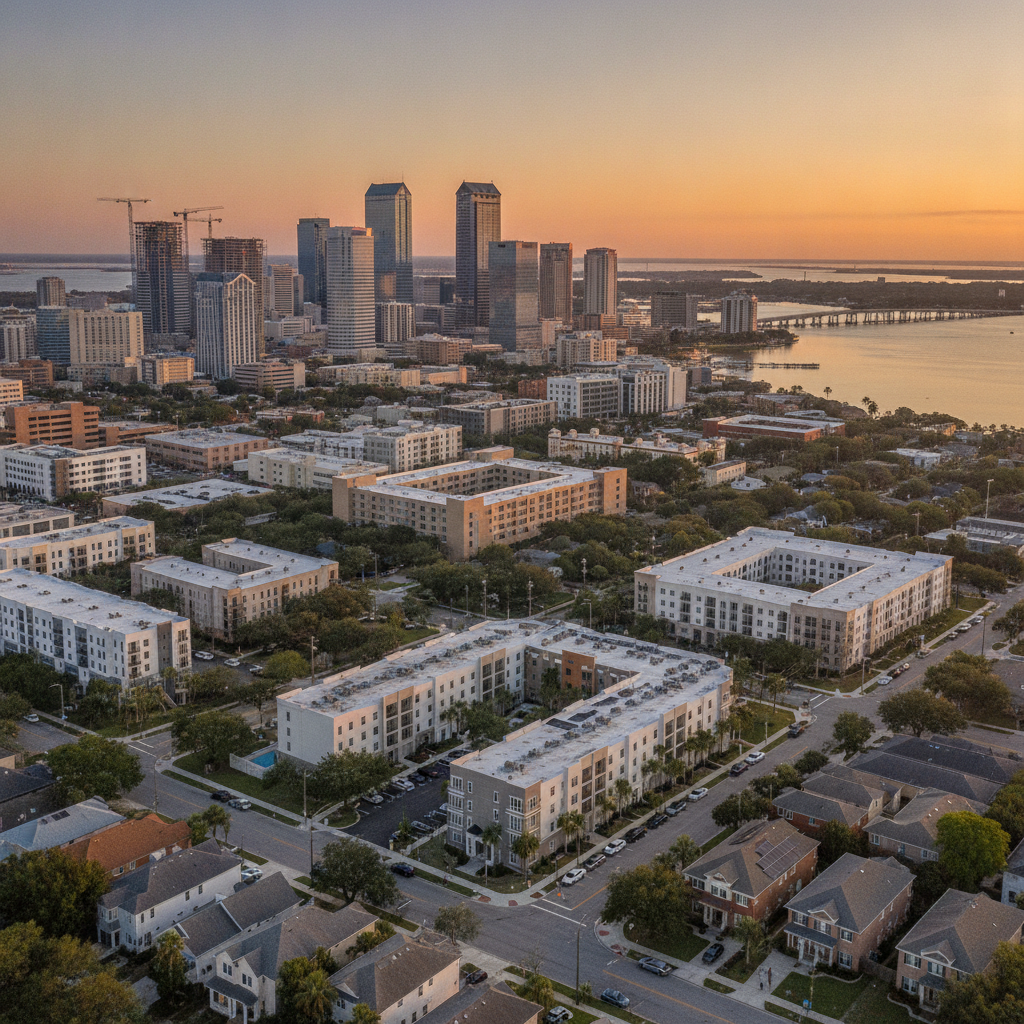
Where Tampa Bay Home Prices Stand Heading Into 2027
Price figures vary depending on geography and property type, which is exactly why so many buyers and sellers feel confused by conflicting headlines. Tampa city, Hillsborough County, Pinellas County, Pasco County, and the broader metro area each report slightly different medians, and single-family homes, condos, and townhomes behave differently within the same zip code.
Broadly speaking, most current estimates place the typical single-family home price in the $420,000 to $430,000 range as of late 2026. That figure is the starting point for most 2027 projections, since forecasters typically apply a percentage adjustment to this baseline rather than predicting an entirely new price level.
Quick Facts
- Typical single-family price baseline: $420,000-$430,000
- Condo and townhome trend: softer pricing versus single-family homes
- Waterfront and flood-zone properties: facing insurance-driven headwinds
- Inland, newer-construction homes: relatively more resilient pricing
Will Tampa Bay Home Prices Rise or Fall in 2027?
This is the single most common question behind any Tampa Bay real estate market forecast 2027, and the honest answer is: it depends heavily on mortgage rates, employment stability, and insurance costs. Rather than offering one number, most serious regional analyses present three plausible scenarios.
| Scenario | Likely 2027 Price Change | Main Conditions |
|---|---|---|
| Base case | -1% to +3% | Mortgage rates hold in the low-to-mid 6% range; employment stays stable; insurance costs rise gradually |
| More favorable case | +2% to +5% | Rates drift toward 6% or below; affordability improves; buyer demand strengthens |
| Downside case | -6% to -10% | Rates stay at or above 7%; unemployment rises; insurance availability worsens; or a major storm disrupts the market |
These ranges originate from a 2026 regional housing outlook rather than a government projection, so they should be treated as informed scenarios rather than guarantees (regional market analysis, https://www.zillow.com). Still, the consensus among multiple market observers is consistent: stabilization or gradual appreciation is more likely than a sharp move in either direction, assuming rates and insurance markets don't deteriorate sharply.
Most current scenarios point to a base case of roughly flat to +3% price growth, assuming mortgage rates remain in the low-to-mid 6% range and the regional economy avoids a significant slowdown.
Is a Tampa Bay Housing Market Crash Coming in 2027?
Given how often "housing crash" searches spike around forecast season, it's worth addressing directly: a crash is not the base-case outcome in any credible Tampa Bay real estate market forecast 2027. The conditions that produced the 2008 collapse — widespread subprime lending, minimal down payments, and speculative overbuilding — simply aren't present at the same scale today. Lending standards remain considerably tighter, and much of the recent inventory growth reflects a return to normal supply rather than reckless overbuilding.
That said, downside risk is real in specific segments. Older condominiums facing steep special assessments, homes in high-risk flood zones with rapidly rising insurance premiums, and overpriced listings that have sat on the market for months are the properties most vulnerable to meaningful price corrections in 2027 — even if the broader Tampa Bay real estate market forecast 2027 remains stable overall.
Inventory, New Construction, and the Supply Equation
Inventory is arguably the single biggest variable shaping the Tampa Bay real estate market forecast 2027, and it behaves very differently across property types.
On the resale single-family side, supply sits around 3.8 to 4.0 months — enough to give buyers real choices and negotiating room, but not so much that sellers are getting overwhelmed with competition. On the multifamily side, the picture is quite different. Roughly 11,000 apartment units were under construction across the region as of 2026, concentrated in Downtown Tampa, Pasco County, Central Pinellas, and Downtown St. Petersburg (regional development data, https://www.realtor.com). Separately, one rental-market projection estimated approximately 7,559 apartment deliveries in 2026 alone, representing roughly 4.5% growth in rental stock.
This surge in rental supply matters for the Tampa Bay real estate market forecast 2027 in two ways. First, it could soften rent growth, which in turn affects the buy-versus-rent calculation for first-time buyers. Second, heavy apartment construction in specific submarkets like Downtown Tampa and Central Pinellas could create localized price softness for competing condo products, even while single-family homes in the same broader area hold value more effectively.
Mortgage Rates, Insurance, and Affordability Pressures
Every scenario in the Tampa Bay real estate market forecast 2027 hinges on two cost factors that have little to do with local supply and demand: mortgage rates and property insurance.
Mortgage rates in the low-to-mid 6% range underpin the base case for modest price stability. If rates drift toward or below 6%, pent-up demand from buyers who have been sitting on the sidelines could push prices toward the more favorable +2% to +5% scenario. Conversely, if rates climb back toward 7% or higher, affordability erosion could push the market into the -6% to -10% downside scenario, particularly for higher-priced coastal and luxury segments.
Insurance costs add a distinctly Florida-specific variable. Rising premiums, and in some cases reduced insurer availability, have already pushed some buyers away from older coastal properties and toward newer, inland, or elevated construction. This dynamic is expected to continue shaping the Tampa Bay real estate market forecast 2027, with insurance-sensitive properties facing more price pressure than comparable inland homes.
Significantly. Properties in flood-prone or older coastal buildings face rising premiums and, in some cases, difficulty securing coverage at all, which is a key reason forecasts distinguish between resilient inland markets and more vulnerable waterfront and older-condo segments.
What Buyers Should Do to Prepare for 2027
Buyers navigating the Tampa Bay real estate market forecast 2027 have more time and leverage than they did a few years ago, but preparation still matters enormously in a market with meaningful local variation.
- Get a true affordability picture, including insurance. Ask for a full insurance quote before falling in love with a property, especially anything built before 2000 or located near flood zones.
- Compare submarkets, not just price tags. A $430,000 home in inland Pasco County and a $430,000 condo in a flood zone carry very different risk and carrying-cost profiles.
- Watch days-on-market as a negotiating signal. Properties sitting well beyond the typical 38-day window often reflect pricing or condition issues you can use in negotiations.
- Get pre-approved and monitor rate movement. A shift from 7% to 6% on a $400,000 loan can change your monthly payment by hundreds of dollars, directly affecting what the Tampa Bay real estate market forecast 2027 means for your personal budget.
- Work with an agent who understands localized risk. Insurance availability, flood zones, and HOA financial health vary block by block in Tampa Bay.
Kyle Hollister works with buyers across Greater Tampa Bay, South Tampa, St. Petersburg, and Wesley Chapel to translate broad market forecasts into decisions specific to a buyer's budget and risk tolerance. You can learn more about working with a locally grounded advisor at Hollister Real Estate.
What Sellers Should Do to Prepare for 2027
Sellers face a different set of considerations under the Tampa Bay real estate market forecast 2027. With supply hovering near 4 months, well-priced, well-maintained homes still move relatively quickly — but overpriced or poorly positioned listings risk sitting on the market and eventually taking price cuts.
- Price realistically from day one. In a balanced market, the "test the market high" strategy tends to backfire, often resulting in a lower final sale price after multiple reductions.
- Understand your specific submarket. A home in a flood-prone waterfront zone may face a materially different buyer pool than an inland, newer-construction neighborhood, even if headline county-wide data looks stable.
- Anticipate insurance-related buyer questions. Be ready with recent insurance quotes, roof age, and any storm-hardening improvements, since these increasingly influence buyer decisions and financing approval.
- Factor in the 38-day benchmark. If your home isn't generating strong showing activity within the first few weeks, that's an early signal to revisit pricing rather than waiting for the market to catch up.
For sellers weighing timing decisions against the broader Tampa Bay real estate market forecast 2027, working with an advisor who can walk through localized inventory and pricing data — not just county-wide averages — often makes the difference between a smooth sale and a prolonged listing. Reach out through Hollister Real Estate for a market-specific consultation.
Neighborhood Variation: Where Tampa Bay Outperforms or Lags in 2027
Perhaps the most important nuance in any Tampa Bay real estate market forecast 2027 is that county-wide and metro-wide averages mask substantial neighborhood-level differences.
Newer, inland communities in Pasco County and parts of eastern Hillsborough County — where insurance costs are generally lower and new construction has kept supply relatively fresh — tend to show more price resilience. Meanwhile, older coastal condominiums, particularly buildings constructed before more recent structural inspection and reserve-funding requirements, face continued pressure from insurance costs and special assessments. Downtown submarkets with heavy apartment construction may see softer condo pricing simply due to increased rental competition.
No. Inland, newer-construction areas with lower insurance costs are expected to outperform older coastal condos and flood-prone waterfront properties, even within the same overall market forecast.
This is why a single Tampa Bay real estate market forecast 2027 number — whether -1% or +5% — should always be treated as a regional average rather than a prediction for any specific street or building. Buyers and sellers who understand this nuance are better positioned to make sound decisions regardless of which broad scenario ultimately plays out.
Frequently Asked Questions
What is the Tampa Bay real estate market forecast 2027?
The base-case forecast calls for roughly -1% to +3% price change year over year, assuming mortgage rates stay in the low-to-mid 6% range and the regional economy remains stable. More favorable conditions (rates near or below 6%) could push growth to +2% to +5%, while a downside scenario involving rates above 7% or a major storm could bring declines of -6% to -10%.
Will Tampa Bay home prices crash in 2027?
A crash is not the base-case scenario. Current inventory levels of roughly 3.8 to 4.0 months reflect a market moving toward balance rather than the severe oversupply and lending failures that caused the 2008 crash. Specific segments like older waterfront condos with insurance issues carry more downside risk than the broader market.
How much housing inventory does Tampa Bay have heading into 2027?
Estimates place single-family supply around 3.8 months and overall Tampa-area supply near 4.0 months as of late 2026, which is generally considered a balanced market rather than a strongly buyer- or seller-favored one.
Is it a good time to buy a home in Tampa Bay before 2027?
For buyers with stable finances and a multi-year time horizon, current conditions offer more negotiating room than the pandemic-era market did. The right timing depends more on personal financial readiness and mortgage rate access than on trying to perfectly time a market that is expected to remain relatively stable.
How do mortgage rates affect the Tampa Bay real estate market forecast 2027?
Mortgage rates are one of the two biggest variables in every 2027 scenario. Rates in the low-to-mid 6% range support flat-to-modest price growth, rates near or below 6% support stronger appreciation, and rates sustained at or above 7% are a key driver of the downside price scenario.
Conclusion: Planning Around the 2027 Tampa Bay Outlook
The clearest takeaway from this Tampa Bay real estate market forecast 2027 is that broad stability, not extreme movement, is the most likely outcome — but that stability hides real variation by neighborhood, property type, and insurance exposure. Buyers who prepare their financing and understand localized risk, and sellers who price realistically from the start, are best positioned to navigate whichever scenario ultimately unfolds.
If you're planning a purchase or sale in Tampa Bay and want a data-driven read on your specific neighborhood, property type, or timeline, Kyle Hollister brings an analytical, engineering-informed approach to helping buyers and sellers make sound decisions in a changing market. Visit Hollister Real Estate to start a conversation about your 2027 plans.