Best Time to Buy a House in Tampa Bay and Why It Matters
November 22, 2026 · 13 min read

If you've been waiting for a sign to start house hunting, here it is: the best time to buy a house in Tampa Bay isn't a myth, and it isn't random either. It's a predictable seasonal pattern shaped by inventory, buyer competition, and how motivated sellers are to negotiate. Understanding this pattern can mean the difference between overpaying in a bidding war and closing on your dream home thousands of dollars under list price. This guide breaks down exactly when — and why — timing matters so much in the Tampa Bay market.
TL;DR — The Bottom Line
The best time to buy a house in Tampa Bay is generally early November through February, when buyer competition drops, price reductions become more common, and sellers are more willing to negotiate on price, repairs, and closing costs. Late summer through fall offers a middle-ground option with more inventory, while January through April brings the most competition from relocation buyers and seasonal residents. The right timing ultimately depends on whether you're prioritizing price, selection, or speed.
Quick Facts
- Best overall buying window: Early November through February
- Months of supply, Tampa Bay region: Approximately 3.8 to 5.4 months (balanced market range)
- Median days on market: Around 71 days regionally
- Listings with price reductions: About 25.8% of active listings
- Tampa median sale price: Approximately $430,000, up about 2.4% year over year
- Most competitive buying months: January through April
Why the Best Time to Buy a House in Tampa Bay Isn't the Same for Everyone
Ask ten real estate agents when to buy, and you'll likely get ten slightly different answers — because "best" depends on what you're optimizing for. A buyer chasing the lowest possible price will time things differently than a relocating family that needs to be in a school district by August, or an investor who wants the widest pool of inventory to compare.
That said, when real estate analysts talk about the best time to buy a house in Tampa Bay, they're almost always referring to the window where buyers gain the most leverage: lower competition, more price flexibility from sellers, and homes sitting on the market long enough to negotiate seriously.
In Tampa Bay, that window consistently lands in late fall and winter. But it's not the only window worth knowing about, and it's not automatically right for every buyer. Let's look at the data.
Tampa Bay Housing Market Snapshot
Before timing a purchase, it helps to understand where the Tampa Bay market stands overall. Recent market reporting describes the region as broadly balanced rather than strongly tilted toward buyers or sellers, which is a meaningful shift from the extreme seller's market of 2021–2022.
- Active listings range from roughly 20,989 homes regionwide to lower totals when isolating single-family homes in specific counties.
- Inventory sits at approximately 3.8 to 5.4 months of supply in most estimates, near the textbook 3-to-6-month balanced-market range.
- One regional estimate places supply at 5.2 months, with homes taking a median 71 days to sell and closing at about 96.9% of original list price.
- Roughly 25.8% of active listings have had at least one price reduction — a clear signal that buyers have more negotiating room than they did a few years ago.
- Median prices vary by county: approximately $405,000 in Hillsborough, $425,000 in Pinellas, and $345,000 in Pasco.
- Tampa's citywide median sale price is estimated near $430,000, up about 2.4% year over year.
These figures vary depending on whether a source measures the city of Tampa, the broader metro, or specific counties, and whether condos and townhomes are included alongside single-family homes. That's exactly why evaluating the best time to buy a house in Tampa Bay requires looking at both regional trends and the specific neighborhood or property type you're targeting.
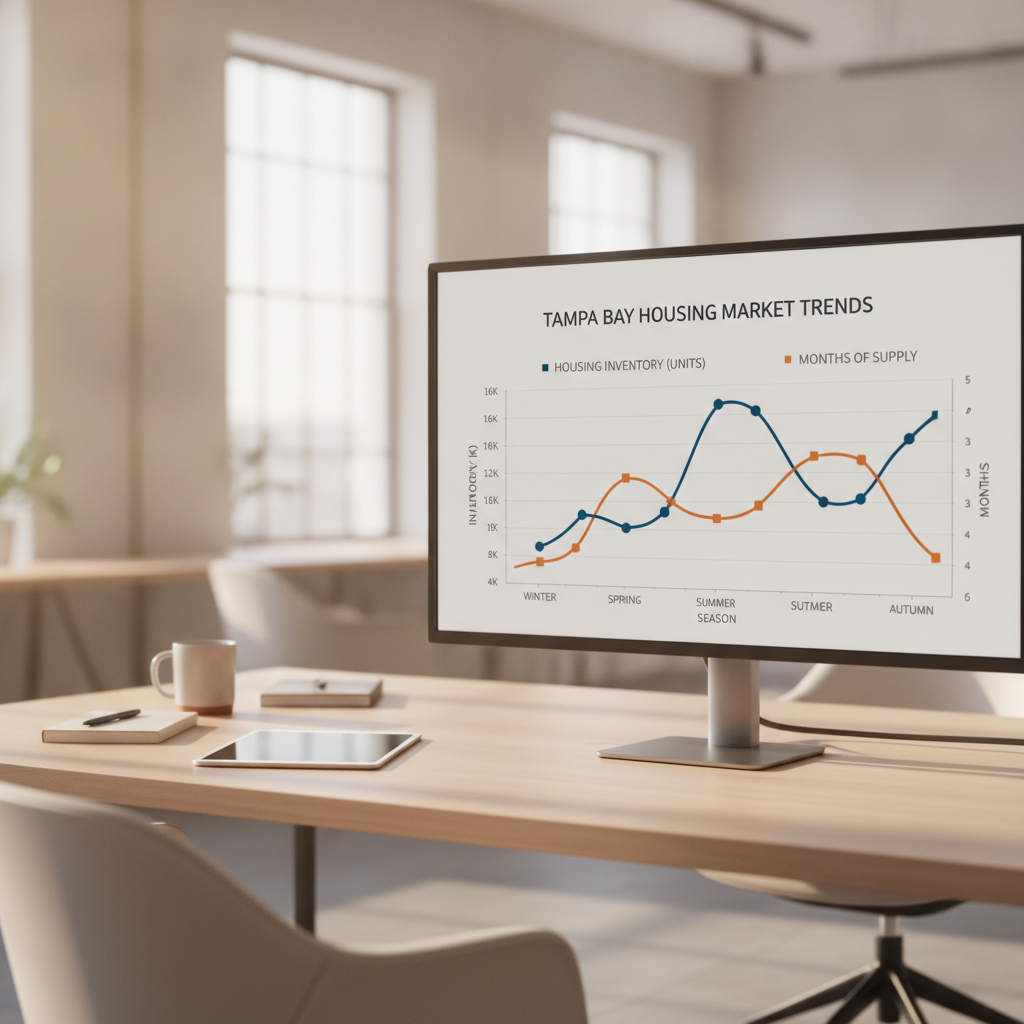
The Best Time to Buy a House in Tampa Bay: Early November Through February
If your top priority is price, the strongest evidence points to early November through February as the best time to buy a house in Tampa Bay. Market analysis identifies early November specifically as a strong starting point, since homebuying activity naturally slows as the holidays approach and sellers face far fewer competing buyers.
Local market analysis also points to September through November as a favorable stretch, because seasonal demand hasn't fully rebounded yet, and sellers who listed back in summer may be increasingly motivated to close before year-end for tax planning or relocation deadlines.
During this period, buyers typically see:
- Less competition from spring relocation buyers and seasonal residents
- Greater seller flexibility on price, closing costs, repair credits, or interest rate buydowns
- More stale listings and price reductions, giving buyers data to support lower offers
- Stronger inspection and appraisal leverage, since sellers are less likely to have backup offers
- Sellers motivated by year-end timing, whether for tax reasons or a pending move
The trade-off is selection. Some sellers intentionally hold off listing during the holidays, which means the overall pool of available homes shrinks even as competition does. Desirable, well-priced homes can still attract multiple offers if a listing is priced correctly for its neighborhood.
It still holds up in current data. While the overall market has cooled from pandemic-era intensity, seasonal patterns persist: competition drops in late fall and winter, price reductions climb, and sellers who are still listing during that window tend to be more motivated. The caveat is that inventory is also lower, so buyers trade some selection for negotiating power.
Late Summer and Fall: A Smart Middle-Ground Window
Not every buyer can wait until November, and not every buyer wants to sacrifice selection for negotiating leverage. Late summer through fall offers a useful compromise, and for some buyers, it may actually be the best time to buy a house in Tampa Bay given their specific needs.
One recent report found that Tampa asking prices were about 4.9% below the seasonal peak during this period, active listings were roughly 12.7% above the annual average, and homes were taking about 19 days longer to sell compared to the fastest spring months. That combination — more homes to choose from, slightly softer pricing, and slower sales pace — creates real opportunity without the thin inventory of deep winter.
| Season | Inventory Level | Buyer Competition | Price Leverage | Best For |
|---|---|---|---|---|
| Late Summer–Fall (Aug–Oct) | Above average | Moderate | Good | Buyers needing more selection without waiting until winter |
| Early Winter (Nov–Feb) | Below average | Lowest | Strongest | Buyers prioritizing price and negotiating power |
| Spring (Mar–Apr) | Rising | High | Weak | Buyers who need the widest selection and can move fast |
| Early Summer (May–Jun) | Peak | Highest | Weakest | Relocating families tied to school schedules |
This fall window is especially attractive for:
- Buyers who need more choices than the holiday season provides
- Relocating households that can't wait until January to move
- Condo and townhome buyers, where inventory has been reported at six months of supply or more in some analyses
- Buyers who are comfortable negotiating rather than competing in multiple-offer situations
When Competition Peaks: January Through April
Here's where seasonal timing gets a little counterintuitive. Although winter is generally considered a buyer-friendly period, the back half of it — roughly January through April — can become increasingly competitive, especially for well-priced single-family homes in desirable Tampa Bay neighborhoods.
Several groups converge on the market during this stretch: seasonal residents finalizing winter purchases, relocation buyers aiming to close before the school year, and households trying to beat the spring price run-up. The result is that homes priced correctly often move quickly, and the negotiating leverage buyers enjoyed in November and December starts to fade by March.
Matching the Best Time to Buy a House in Tampa Bay to Your Priorities
There isn't a single universal answer because "best" depends on what matters most to you. Here's how timing shifts based on your primary goal:
- If price is your top priority: Target early November through February, when price reductions and seller motivation peak.
- If selection is your top priority: Target late summer through early fall, when inventory is above average but competition hasn't fully returned.
- If financing and rate negotiation matter most: Winter sellers are more likely to agree to rate buydowns or closing cost credits, since they have fewer competing buyers to fall back on.
- If speed is your top priority: Spring offers the most listings to choose from, though you'll likely pay closer to full asking price and move faster to compete.
It's usually your flexibility. If you can wait and negotiate, late fall through winter gives you the most leverage. If you're on a hard deadline — a job relocation, a lease ending, or a school year starting — your "best time" is really whenever a well-priced home that fits your needs becomes available, and a skilled local agent can help you move on it quickly.
A Simple Framework for Timing Your Purchase
- Define your priority: Decide whether price, selection, or speed matters most for your situation.
- Get pre-approved early: Lock in financing readiness before your target window so you can move the moment the right listing appears.
- Track local inventory trends: Watch months-of-supply and price-reduction data in your target neighborhoods, not just citywide averages.
- Time your offer strategy to the season: Negotiate aggressively in November–February; move decisively in spring if speed matters more than price.
- Work with a local agent who understands seasonal patterns: Timing advantages only pay off if you have someone who can translate market data into a specific offer strategy.
Neighborhood, Property Type, and Local Nuances
Citywide and county-level statistics are useful starting points, but the best time to buy a house in Tampa Bay can vary meaningfully by neighborhood and property type. A single-family home in a highly sought-after South Tampa school zone may see almost no seasonal softening, because demand there rarely slows down. Meanwhile, condo and townhome markets — which have shown higher months-of-supply in several recent reports — tend to offer buyers leverage for longer stretches of the year, not just in winter.
Flood zone designation, insurance costs, and HOA fees also shape how quickly a given property moves, regardless of season. A well-priced home in a lower-risk flood zone with reasonable insurance costs may sell quickly even in a traditionally slow month, while a higher-risk property might sit on the market longer even during peak spring demand. This is why evaluating comparable sales in your specific target neighborhood matters more than relying on regional averages alone.
Relocating buyers comparing Tampa, South Tampa, St. Petersburg, Wesley Chapel, and Lakeland should also expect timing patterns to shift slightly by submarket, since each area attracts different buyer profiles — from waterfront retirees to young families to remote professionals.
How a Local Agent Helps You Capture the Best Time to Buy a House in Tampa Bay
Knowing the general seasonal pattern is useful, but translating it into a winning offer requires local, current data. A buyer working without guidance might see a home sitting on the market for 60 days and assume it's simply undesirable, when in reality it's priced slightly above comparable sales and ripe for a reasonable, below-asking offer with repair credits included.
This is where working with an experienced local advisor pays off. Negotiation strategy, neighborhood-level data on flood zones and insurance exposure, and an honest read on whether a listing is overpriced or fairly priced all matter more than the calendar date alone. Kyle Hollister works with Tampa Bay buyers and sellers across Tampa, South Tampa, St. Petersburg, Wesley Chapel, and Lakeland to turn seasonal market data into a specific, actionable offer strategy rather than generic advice.
For sellers, understanding these same patterns matters too — listing during a competitive window versus a slower one can significantly affect how quickly a home sells and how much negotiating room buyers expect. Reach out through hollister-realestate.com to get a current read on where your specific neighborhood stands right now.
Frequently Asked Questions
What is the best time to buy a house in Tampa Bay?
The best time to buy a house in Tampa Bay for most buyers is early November through February, when competition eases, price reductions become more common, and sellers are generally more willing to negotiate on price and terms. Buyers prioritizing selection over price may prefer late summer through fall instead.
Is Tampa Bay currently a buyer's market or a seller's market?
Recent data describes Tampa Bay as broadly balanced, with months-of-supply estimates ranging from about 3.8 to 5.4 months and roughly a quarter of listings showing price reductions. This is far more favorable to buyers than the extremely tight seller's market seen in 2021–2022, though it isn't a strongly buyer-favored market either.
Why do home prices drop in winter in Tampa Bay?
Prices and competition typically soften in winter because fewer buyers are actively searching during the holidays, and sellers who remain on the market tend to be more motivated to close before year-end for financial or relocation reasons. This reduced competition gives buyers more room to negotiate on price and terms.
Should I wait until spring to buy a house in Tampa Bay?
Waiting until spring gives you more homes to choose from, but it also means competing with significantly more buyers, which often erases much of the negotiating leverage available in late fall and winter. If price is a higher priority than selection, waiting until spring is usually not the optimal strategy.
Does the best time to buy a house in Tampa Bay vary by neighborhood?
Yes. Highly desirable neighborhoods and school zones can stay competitive year-round, while condo, townhome, and less central markets tend to offer buyers leverage for longer stretches of the year. Evaluating local inventory and days-on-market data for your specific target area is more reliable than relying on citywide averages alone.
Final Thoughts: Timing Is a Tool, Not a Guarantee
The best time to buy a house in Tampa Bay isn't a single magic date — it's a seasonal pattern you can use strategically. Early November through February consistently offers the strongest combination of reduced competition and seller motivation, while late summer and fall provide a useful middle ground for buyers who need more selection. Spring and early summer bring the most inventory but also the toughest competition, often eroding much of the price advantage buyers gained earlier in the year.
What matters most is aligning the calendar with your personal priorities — price, selection, or speed — and pairing that timing with accurate, neighborhood-level data rather than broad citywide averages. A home that looks "stale" after 60 days on the market in November might actually represent the best negotiating opportunity of the year.
If you're ready to put this seasonal strategy to work, whether you're buying your first home, relocating to Tampa Bay, or getting ready to sell, connect with Kyle Hollister for a current, neighborhood-specific read on where the market stands today and how to time your next move with confidence.