Tampa Bay vs St Petersburg Real Estate: Which Fits You?
October 3, 2026 · 13 min read
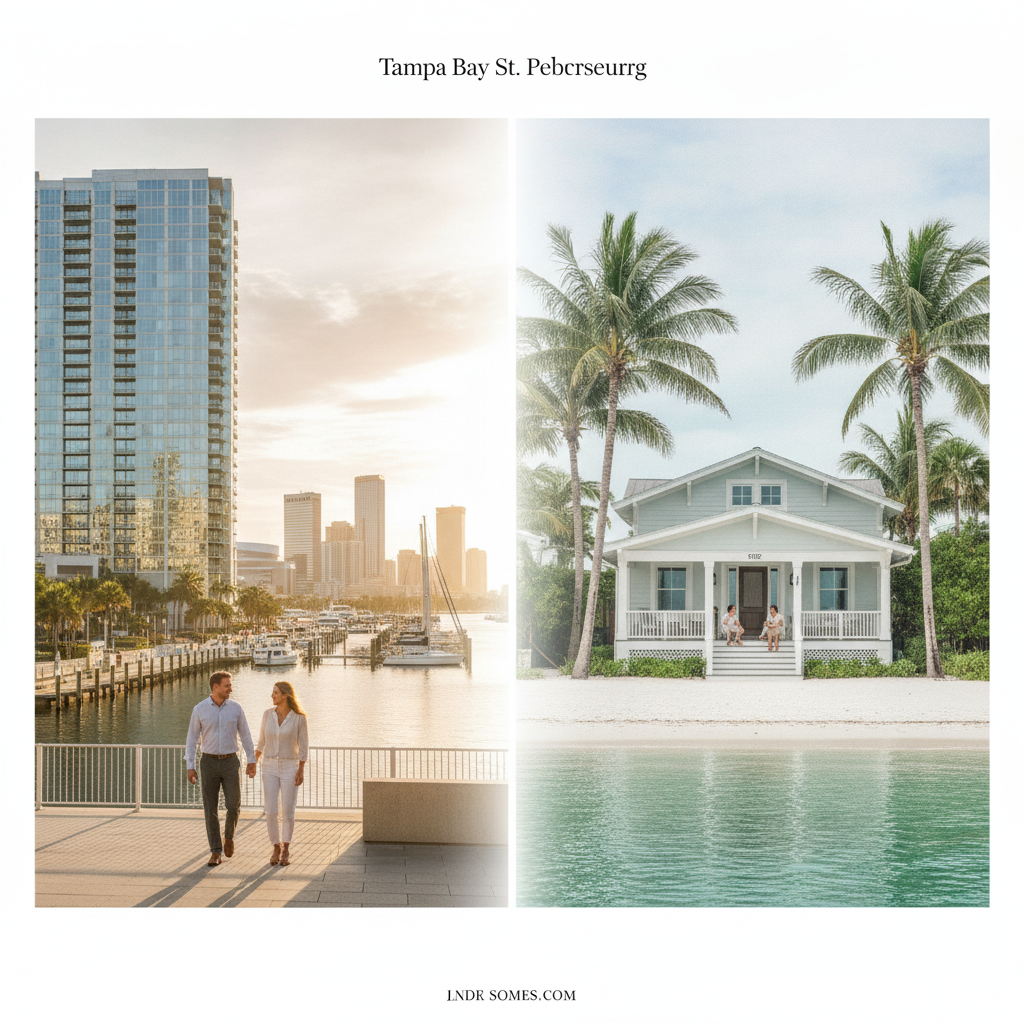
Choosing between tampa bay vs st petersburg real estate is one of the most consequential decisions a buyer or seller in the region will make this year. Both markets sit along the same bay, share many of the same employers, and attract similar relocation buyers — yet they behave very differently once you look past the headline numbers. This guide breaks down the tampa bay vs st petersburg real estate comparison using current pricing, inventory, negotiation trends, and lifestyle factors so you can decide which side of the water actually fits your goals.
TL;DR — The Bottom Line
In the tampa bay vs st petersburg real estate comparison, Tampa generally offers broader housing choice, stronger employment-driven demand, and more suburban value, while St. Petersburg offers a denser, walkable, coastal lifestyle with higher flood and insurance exposure. Tampa's median sale price runs higher (around $479,000 versus roughly $430,000 in St. Petersburg), but St. Petersburg buyers are negotiating harder, with homes selling about 2.65% below asking price versus 1.82% in Tampa. Neither market is universally "better" — the right answer depends on your budget, risk tolerance, and lifestyle priorities.
Quick Facts
- Tampa median sale price: approximately $479,000 (three months ending August 2026)
- St. Petersburg median sale price: approximately $430,000 (three months ending August 2026)
- Tampa annual price change: +10.0% year-over-year
- St. Petersburg annual price change: +7.4% year-over-year
- Tampa inventory: about 3,157 homes for sale as of August 31, 2026
- St. Petersburg inventory: about 2,419 homes for sale as of August 31, 2026
Tampa Bay vs St Petersburg Real Estate: A Market Snapshot
Before diving into neighborhood-level detail, it helps to see how the two markets stack up side by side. Every data provider — Redfin, Zillow, and Realtor.com — measures things slightly differently, so treat these as directional indicators rather than exact twins.
| Metric | Tampa | St. Petersburg |
|---|---|---|
| Median sale price | ~$479,000 | ~$430,000 |
| Annual price change | +10.0% | +7.4% |
| Typical days on market | ~46 days | Varies by source |
| Active inventory (Aug 31, 2026) | ~3,157 homes | ~2,419 homes |
| Median sale-to-list ratio | 98.0% | 97.3% |
| Typical negotiation below asking | -1.82% | -2.65% |
According to Redfin's three-month data ending August 2026, Tampa posted a median sale price of $479,000 with a 10.0% year-over-year gain, while St. Petersburg recorded a $430,000 median and a 7.4% increase over the same window.1 Zillow's city-level figures showed 3,157 active Tampa listings and 2,419 in St. Petersburg as of August 31, with sale-to-list ratios of 98.0% and 97.3%, respectively.2 Realtor.com reported that September closings landed about 1.82% below asking price in Tampa and 2.65% below asking in St. Petersburg, suggesting slightly more buyer leverage on the Pinellas County side of the bay.3
A fair reading of the tampa bay vs st petersburg real estate data is this: Tampa is the larger, more price-resilient market, while St. Petersburg is smaller, pricier per square foot in its core neighborhoods, and currently offering buyers a bit more room to negotiate.
Tampa: Who This Side of the Bay Fits Best
Tampa tends to win the tampa bay vs st petersburg real estate debate for buyers who prioritize job access, commuting flexibility, and a wider range of price points. The city spans downtown high-rises, established urban neighborhoods like Seminole Heights and West Tampa, and sprawling suburban communities in New Tampa and Carrollwood.
- Employment access: Tampa's diversified economy, proximity to Tampa International Airport, and downtown employment corridor support steady owner-occupant demand.
- Housing variety: Buyers can choose among condos, townhomes, established single-family homes, and new-construction subdivisions.
- Lower flood exposure in many pockets: Inland Tampa neighborhoods often sit at higher elevation than coastal Pinellas County, though buyers must still verify flood zones property by property.
- More time to decide: With homes averaging about 46 days on market, Tampa buyers generally face less urgency than they did during the pandemic-era boom.
Not necessarily on a per-square-foot basis in the urban core, but Tampa's median sale price of roughly $479,000 reflects a broader mix of larger suburban homes, while St. Petersburg's lower citywide median of about $430,000 can mask higher prices in its most desirable coastal and historic neighborhoods.
Tampa is not without trade-offs. New-construction competition can pressure resale sellers, particularly those with older homes lacking updated roofing, HVAC systems, or storm-resistant features. Neighborhood performance also varies widely — South Tampa behaves nothing like the outer suburbs — which is why any serious tampa bay vs st petersburg real estate decision should be grounded in neighborhood-level data, not citywide averages alone.
St. Petersburg: Who This Side of the Bay Fits Best
St. Petersburg generally appeals to buyers who want a compact, walkable, coastal lifestyle — downtown waterfront parks, a strong arts and dining scene, and shorter drives to the Gulf beaches. It's a smaller market than Tampa, with roughly 2,419 active listings compared to Tampa's 3,157 as of late August 2026, which can mean fewer choices but also a tighter, more curated inventory in popular pockets.
- Lifestyle and walkability: Downtown St. Petersburg, Old Northeast, and the Grand Central District offer dense, pedestrian-friendly living that's harder to find on the Tampa side.
- Stronger negotiation position for buyers currently: Homes sold about 2.65% below asking price in September 2026, compared to 1.82% in Tampa, suggesting more room to negotiate on price or concessions.
- Higher coastal and flood exposure: Much of St. Petersburg sits closer to sea level and closer to the Gulf, which translates into greater insurance costs and more properties requiring flood elevation certificates.
- Condo-market complexity: Post-Surfside reserve requirements and rising HOA assessments have added scrutiny to condo purchases throughout Pinellas County.
Comparing Costs, Insurance, and Flood Risk
No tampa bay vs st petersburg real estate comparison is complete without addressing the cost of ownership beyond the purchase price. Florida's property insurance market has tightened considerably, and location within the bay area has a direct effect on premiums, deductibles, and even insurability.
St. Petersburg's geography — a peninsula surrounded by Tampa Bay and the Gulf of Mexico — means a larger share of its housing stock sits in designated flood zones or within wind-borne debris regions that carry higher windstorm premiums. Tampa has coastal and low-lying exposure too, particularly near Davis Islands, Harbour Island, and sections of South Tampa, but a larger share of its inventory sits farther inland or at higher elevation.
Practical steps for either market:
- Pull the FEMA flood zone designation for any specific property, not just the city or ZIP code average.
- Request the seller's current insurance declarations page and claims history during due diligence.
- For condos, review the HOA's most recent reserve study and milestone inspection status before making an offer.
- Factor windstorm and flood premiums into your monthly payment comparison, not just the mortgage principal and interest.
Lifestyle and Neighborhood Differences That Matter
Beyond price and risk, the tampa bay vs st petersburg real estate decision often comes down to day-to-day lifestyle. Tampa offers more variety in commute patterns and home styles — buyers can choose dense urban living in downtown Tampa, family-oriented suburbs in New Tampa, or historic bungalows in Seminole Heights. St. Petersburg offers a more unified, compact identity centered on its downtown waterfront, arts district, and beach proximity.
Commuters working primarily on the Tampa side of the bay (downtown Tampa, Westshore, Brandon) often find that living in St. Petersburg adds meaningful bridge-crossing time during peak hours, while those working in Pinellas County or seeking a shorter beach commute may find the reverse true from Tampa.
Both cities fall under county-level millage rates (Hillsborough County for Tampa, Pinellas County for St. Petersburg) that are broadly comparable; the bigger cost differentiator between the two tends to be insurance premiums and flood-zone designation rather than the base property tax rate.
How to Decide Which Side of the Bay Is Right for You
Rather than relying solely on citywide averages, work through a structured process before committing to either side of the tampa bay vs st petersburg real estate equation.
- Define your non-negotiables. List your must-haves: commute distance, school zone, walkability, yard space, or boat access.
- Set a realistic budget that includes insurance. Get a preliminary insurance quote for target neighborhoods before falling in love with a listing.
- Request neighborhood-level comps. Ask for a comparative market analysis specific to the streets you're considering, not a citywide median.
- Visit at different times of day. Traffic, noise, and flood-prone drainage patterns often reveal themselves differently in morning rain versus a dry afternoon.
- Stress-test your resale plan. Consider how easily the property could sell in five to ten years given flood risk, HOA stability, and local employment trends.
Working with a local advisor who tracks both sides of the bay day to day can shortcut much of this research, since neighborhood-level nuances rarely show up in national data feeds.
Common Sub-Questions Buyers Ask About Tampa Bay vs St Petersburg Real Estate
Several recurring questions come up whenever buyers and sellers weigh tampa bay vs st petersburg real estate options. Addressing them directly helps clarify which market fits a given situation.
Is Tampa or St. Petersburg better for first-time buyers?
Tampa generally offers more entry-level inventory and a broader range of price points across its suburbs, making it easier for first-time buyers to find homes within a typical starter budget. St. Petersburg's compact, in-demand core neighborhoods can command a premium that stretches first-time budgets further.
Is St. Petersburg real estate riskier than Tampa due to flooding?
On average, yes — a larger share of St. Petersburg's housing stock sits within flood-prone or coastal wind zones, which typically translates into higher insurance costs. However, risk varies dramatically by specific address and elevation in both cities, so a property-level flood and insurance review always matters more than a citywide generalization.
Which market is more competitive for buyers right now?
Current data suggests St. Petersburg buyers have slightly more negotiating leverage, with homes selling about 2.65% below asking price compared to 1.82% in Tampa, though both markets have cooled from pandemic-era bidding wars.
Frequently Asked Questions
Which is better, Tampa or St. Petersburg real estate?
Neither market is universally better — Tampa suits buyers prioritizing employment access, housing variety, and suburban value, while St. Petersburg suits buyers who want a compact, walkable, coastal lifestyle and are prepared for higher insurance and flood-risk exposure. The right choice in the tampa bay vs st petersburg real estate decision depends on your budget, commute, and lifestyle priorities.
Is it cheaper to buy a home in Tampa or St. Petersburg?
Citywide, Tampa's median sale price (around $479,000) is higher than St. Petersburg's (around $430,000) as of the three months ending August 2026, but premium St. Petersburg neighborhoods like downtown, Old Northeast, and the beaches can exceed Tampa's citywide average.
How long does it typically take to sell a home in Tampa vs St. Petersburg?
Tampa homes were averaging about 46 days on market as of mid-2026, up from roughly 38 days a year earlier. Comparable day-on-market figures for St. Petersburg vary by data source and time period, which is why a local, neighborhood-specific analysis is more reliable than a single citywide number.
Does flood insurance cost more in St. Petersburg than Tampa?
Generally, yes, because a larger proportion of St. Petersburg's housing stock sits in coastal or flood-prone zones due to its peninsula geography. However, specific Tampa neighborhoods near Davis Islands, Harbour Island, and the Hillsborough River can carry similarly high premiums, so property-specific flood zone verification is essential in either city.
Should relocating professionals choose Tampa or St. Petersburg?
Professionals prioritizing a short commute to Tampa's downtown employment corridor, more suburban housing stock, and newer construction often lean toward Tampa, while those seeking a walkable, coastal lifestyle with easy beach access often choose St. Petersburg, even if it means a longer commute to Tampa-side jobs.
Ultimately, the tampa bay vs st petersburg real estate question isn't about which city "wins" — it's about matching current market conditions to your specific budget, risk tolerance, and lifestyle goals. Citywide medians, inventory counts, and negotiation trends are useful starting points, but a neighborhood-level comparative market analysis will always be the deciding factor for any individual purchase or sale.
If you're actively weighing tampa bay vs st petersburg real estate options and want a clear-eyed, neighborhood-specific read on where your budget and goals fit best, Kyle Hollister can walk you through current inventory, insurance considerations, and negotiation trends on both sides of the bay. Reach out today to get a personalized comparison built around your exact priorities rather than a citywide average.
1 Redfin, "Tampa Housing Market" and "St. Petersburg Housing Market," https://www.redfin.com
2 Zillow Research, city-level inventory and sale-to-list data, https://www.zillow.com/research/
3 Realtor.com, local market trends data, https://www.realtor.com/research/