How to Sell a Home with Foundation Issues Tampa Bay
October 27, 2026 · 13 min read

If your property has slab cracks, sloping floors, or a sinkhole claim in its history, you need a clear, legally sound plan for how to sell a home with foundation issues Tampa Bay buyers, lenders, and inspectors will all take seriously. Foundation problems don't automatically mean a fire-sale price or an impossible closing — but they do require a different process than a standard listing. This guide walks through disclosure law, repair-versus-as-is decisions, pricing strategy, and buyer targeting so you can move forward with confidence rather than guesswork.
TL;DR — The Bottom Line
Learning how to sell a home with foundation issues Tampa Bay requires three things: an independent structural evaluation, full and honest disclosure under Florida's Johnson v. Davis standard, and a pricing and marketing strategy that matches your buyer pool — whether that's a repair-ready traditional buyer, an investor, or a cash buyer. Selling "as-is" does not remove your obligation to disclose known material defects, and hiding a problem creates far more legal risk than disclosing it upfront.
Quick Facts
- Legal disclosure standard: Florida requires disclosure of known defects that materially affect value and aren't easily observable (Johnson v. Davis, 1985)
- As-is sales: Still require disclosure of known material defects — as-is only shifts repair negotiation, not honesty obligations
- Sinkhole claims: Florida law requires disclosure of certain paid sinkhole claims and how insurance proceeds were used
- Flood disclosure: Required in writing for qualifying contracts signed on or after October 1, 2024
- Typical first step: An independent structural engineer evaluation, separate from any repair contractor's estimate
What Counts as a Foundation Issue in a Tampa Bay Home?
Not every crack in a Tampa Bay home signals a structural emergency. Florida's heat, humidity, expansive clay-adjacent soils, and seasonal rainfall produce a wide range of cosmetic and structural symptoms, and distinguishing between them is the first step in figuring out how to sell a home with foundation issues Tampa Bay buyers won't walk away from in a panic.
- Cosmetic cracking: Hairline drywall or stucco cracks from normal concrete curing and shrinkage
- Differential settlement: Uneven sinking of one part of the foundation relative to another
- Slab movement: Vertical or lateral shifting of the concrete slab itself
- Stem-wall or block-wall cracking: Diagonal or stair-step cracks in masonry, often near corners
- Drainage-related soil movement: Expansion and contraction from poor grading or standing water near the foundation
- Sinkhole activity: Subsurface voids or raveling that may require geotechnical testing
Warning signs worth noting before you list include doors and windows that stick, visibly sloping floors, cracks that reappear after a patch job, separation around porches or additions, and water intrusion near the slab edge. If you notice any of these, don't guess — get a professional opinion before you price the home or write your disclosure forms.
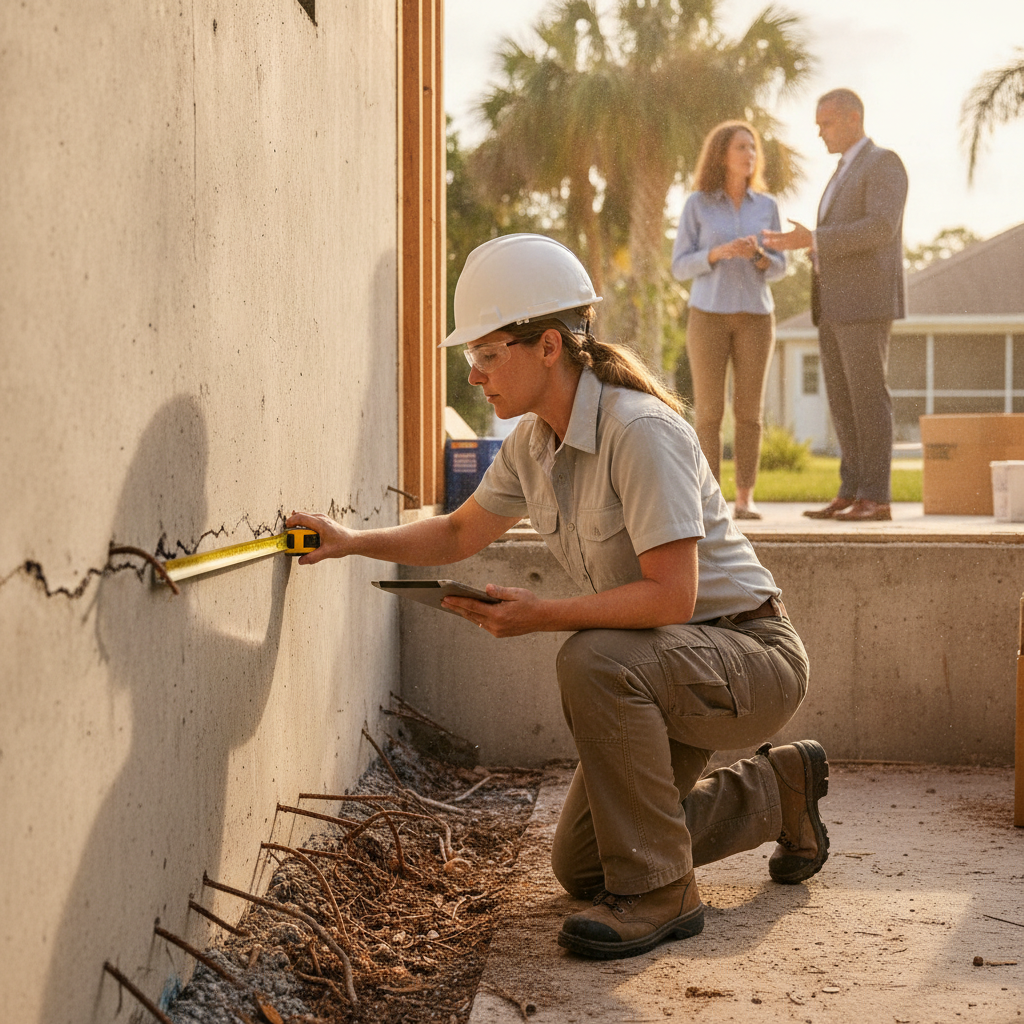
How to Sell a Home with Foundation Issues Tampa Bay: Disclosure Laws You Must Know
Understanding Florida's disclosure law is the legal foundation (no pun intended) of how to sell a home with foundation issues Tampa Bay without exposing yourself to a post-closing lawsuit. Under the landmark case Johnson v. Davis, 480 So. 2d 625 (Fla. 1985), Florida sellers must disclose known conditions that materially affect a property's value or desirability and that a buyer wouldn't reasonably discover on their own.1 This duty exists regardless of whether the contract is written as a standard sale or as a strict as-is agreement.
That means if you know about prior foundation repairs, an engineer's findings, a sinkhole claim, or a pattern of recurring cracking, you must put it in writing — typically on the seller's property disclosure form used in most Tampa Bay transactions. Florida law also imposes special rules around sinkhole claims, including whether a paid claim exists and how any insurance proceeds were used for repair.2 As of contracts signed on or after October 1, 2024, Florida additionally requires a written flood disclosure addressing prior flood damage, insurance claims, and known flood-risk facts — a detail increasingly relevant in flood-prone Tampa Bay zip codes.3
Yes. Selling "as-is" changes who is responsible for repairs and how negotiations proceed, but it does not remove your legal duty to disclose known material defects under Florida's Johnson v. Davis standard. As-is protects you from being obligated to fix the problem — it does not protect you from concealing it.
Full disclosure, paired with a professional engineering report, often reassures buyers more than it scares them away. Buyers fear the unknown far more than a documented, explainable problem. This is one of the most overlooked truths in how to sell a home with foundation issues Tampa Bay successfully: transparency builds trust, and trust closes deals.
Repair First or Sell As-Is? Weighing Your Options
One of the biggest decisions in how to sell a home with foundation issues Tampa Bay sellers face is whether to repair before listing or market the home as-is with a price adjustment. There's no universal right answer — it depends on the cause, scope, and certainty of the problem.
| Repair Before Listing Makes Sense When | Selling As-Is Makes Sense When |
|---|---|
| The cause of movement is clearly identified | The cause is uncertain or still being evaluated |
| Repair scope and cost are predictable | Repair costs vary widely by contractor bid |
| Financing/insurability would otherwise be blocked | Likely buyers are cash or investor buyers anyway |
| Permits and warranties can transfer to the buyer | You need a faster sale timeline |
| Cost is likely recoverable through a higher sale price | Price can clearly reflect the as-is risk |
One important caution: never paint, patch, or re-stucco over active cracking simply to make the home look better for photos. Cosmetic cover-ups don't resolve underlying movement, and if that movement resurfaces after closing, a seller who concealed it faces significantly more legal exposure than one who disclosed it. A documented repair history — permits, invoices, warranties, and before/after photos — almost always improves buyer confidence more than a quick cosmetic fix.
Pricing Strategy for Tampa Bay Homes with Foundation Problems
Pricing is where many sellers get how to sell a home with foundation issues Tampa Bay wrong — either overpricing based on comparable sales that don't share the same condition, or underpricing out of fear and leaving money on the table. The right number starts with an engineer's report, not a gut feeling.
Start by separating three cost categories: the estimated repair cost (get at least two to three bids from licensed, reputable contractors), the discount buyers typically expect for uncertainty or inconvenience, and the value retained by the home's location, lot, and layout. In many Tampa Bay submarkets, waterfront and flood-adjacent lots carry enough underlying land value that a foundation issue reduces but doesn't eliminate buyer interest — it simply changes who's interested and at what number.
Avoid the trap of pricing purely off the repair estimate. Buyers who take on a structural project also factor in financing friction, insurance complications, time, and risk tolerance. A seller who prices a few thousand dollars under the repair estimate alone often still sees the home sit, because sophisticated buyers want a cushion for the unknown. A local agent experienced in how to sell a home with foundation issues Tampa Bay can help you model multiple pricing scenarios against both repaired and as-is comparable sales.
There's no fixed percentage — it depends on the severity, documentation, location, and repair cost. Minor, resolved, and well-documented issues may have minimal impact, while active, undiagnosed, or extensive structural movement can meaningfully reduce buyer interest and offers until repairs or significant price adjustments are made.
Finding the Right Buyer Pool for a Foundation-Challenged Home
Not every buyer is a fit for a structurally compromised property, and part of how to sell a home with foundation issues Tampa Bay effectively is matching your marketing to the right audience instead of hoping a traditional, financing-dependent buyer takes a leap of faith.
Conventional mortgage buyers often face the most friction, since many lenders require clear title to safety and structural soundness before funding, and appraisers may flag unresolved issues. Cash buyers and investors, by contrast, are typically more comfortable absorbing structural risk — but they also price in that risk aggressively, sometimes offering well below market value in exchange for speed and certainty. A well-positioned traditional listing, backed by a professional engineering report and transparent disclosure, can actually widen your buyer pool beyond what either a repair contractor or a cash-buying company would suggest, because it gives conventional buyers and their lenders the documentation needed to move forward with confidence.
A Step-by-Step Process for Selling Successfully
Here is a practical, sequential framework for how to sell a home with foundation issues Tampa Bay from first phone call to closing table:
- Get an independent engineering evaluation. Hire a Florida-licensed structural engineer — not a repair contractor seeking the job — to document probable cause, whether movement is active, and recommended next steps.
- Assemble your documentation package. Gather past inspection reports, repair invoices, permits, insurance claims, photos, and any sinkhole or geotechnical testing results.
- Decide: repair or as-is. Use contractor bids and your timeline to weigh the repair-versus-as-is table above.
- Complete full seller disclosures. Include foundation history, sinkhole claims if applicable, and flood disclosure as required under current Florida law.
- Price using data, not fear. Model pricing against both repaired and as-is comparable sales with the help of an agent experienced in structurally complex properties.
- Market to the right buyer pool. Highlight documentation transparency to attract informed traditional buyers while remaining realistic about investor interest.
- Negotiate with documentation in hand. Be ready to share the engineer's report, repair quotes, and permits during buyer due diligence and inspection periods.
Common Mistakes Sellers Make (And How to Avoid Them)
- Hiding or minimizing known issues. This creates disclosure liability and often surfaces anyway during a buyer's inspection.
- Relying only on a repair contractor's assessment. Contractors may have an incentive to recommend repairs; an independent engineer provides more objective documentation.
- Cosmetic patching instead of real documentation. Painting over cracks doesn't resolve the cause and increases legal risk if movement resumes.
- Pricing off repair cost alone. Buyers also weigh financing friction, insurance, and uncertainty — not just the dollar estimate.
- Marketing to only one buyer type. Going straight to a cash-buying company without testing the broader market can leave money on the table.
- Skipping the flood and sinkhole disclosure details. These are legally distinct requirements from general structural disclosure and are easy to overlook.
Avoiding these missteps is often the real difference-maker in how to sell a home with foundation issues Tampa Bay for a fair price rather than a distressed one.
Frequently Asked Questions
Can I legally sell a house with foundation problems in Florida?
Yes. Florida law does not prohibit selling a home with known structural issues. What the law requires is honest disclosure of known material defects, along with specific disclosures for sinkhole claims and, for qualifying contracts, flood history, regardless of whether the sale is structured as-is or traditionally.
Do I need a structural engineer's report before listing?
It's strongly recommended. A written report from a licensed structural engineer helps you understand the true cause and urgency of the problem, supports accurate pricing, and gives buyers and lenders the documentation they need to move forward with confidence.
Will foundation issues prevent a buyer from getting a mortgage?
It depends on severity and documentation. Unresolved, active, or undiagnosed structural issues can complicate appraisals and lender approval. Clear engineering documentation, completed repairs with permits, or pricing that reflects as-is condition can all help keep financed buyers in play.
Should I repair the foundation before selling or sell as-is?
Repairing first tends to make sense when the cause and cost are well understood and the repair is likely to be recovered through a higher sale price or broader buyer pool. Selling as-is can be more practical when the issue is complex, costs are uncertain, or you need a faster timeline, provided the price reflects that risk.
What is required for sinkhole disclosure in Tampa Bay home sales?
Florida law requires disclosure of certain paid sinkhole claims, including whether insurance proceeds were used for repair. If your property has any sinkhole history, this should be addressed specifically and separately from general structural disclosure, ideally with supporting documentation from the claim and any remediation work.
Selling a home with structural challenges in Florida's competitive coastal market doesn't have to mean accepting a lowball cash offer or carrying undisclosed legal risk. With the right engineering documentation, full legal disclosure, and a pricing and marketing strategy matched to your specific situation, you can navigate how to sell a home with foundation issues Tampa Bay on terms that protect both your finances and your legal standing. Every property and every defect is different, which is why an informed, seller-first approach — rather than a one-size-fits-all repair or cash-sale pitch — tends to produce the strongest outcome.
If you're weighing your options for a Tampa Bay property with foundation, structural, or sinkhole history, Kyle Hollister can help you evaluate your documentation, pricing, and buyer strategy before you list. Reach out through Hollister Real Estate to start the conversation with a clear, honest plan rather than guesswork.
Sources: (1) Johnson v. Davis, 480 So. 2d 625 (Fla. 1985), referenced via The Florida Bar, https://www.floridabar.org. (2) Florida Statutes, Chapter 689, Florida Legislature, https://www.flsenate.gov. (3) Florida flood disclosure requirements for residential contracts, Florida Realtors, https://www.floridarealtors.org.